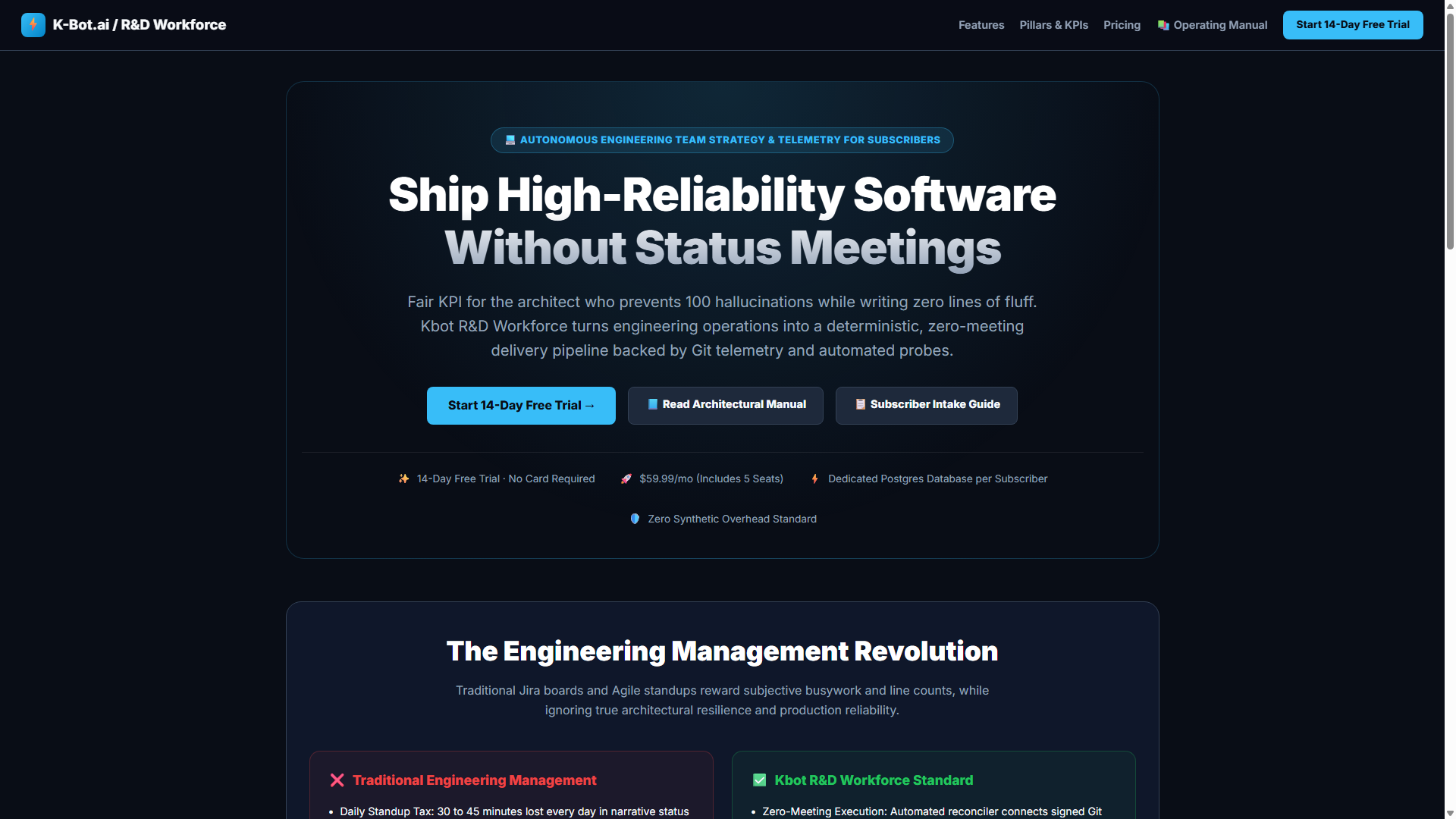
Ship High-Reliability Software Without Status Meetings
Fair KPI for the architect who prevents 100 hallucinations while writing zero lines of fluff. Kbot R&D Workforce turns engineering operations into a deterministic, zero-meeting delivery pipeline backed by Git telemetry and automated probes.
The Engineering Management Revolution
Traditional Jira boards and Agile standups reward subjective busywork and line counts, while ignoring true architectural resilience and production reliability.
7 Outcome Pillars & Balanced 8.0h Budgeting
Engineered for CTOs, engineering leads, and distributed remote development teams.
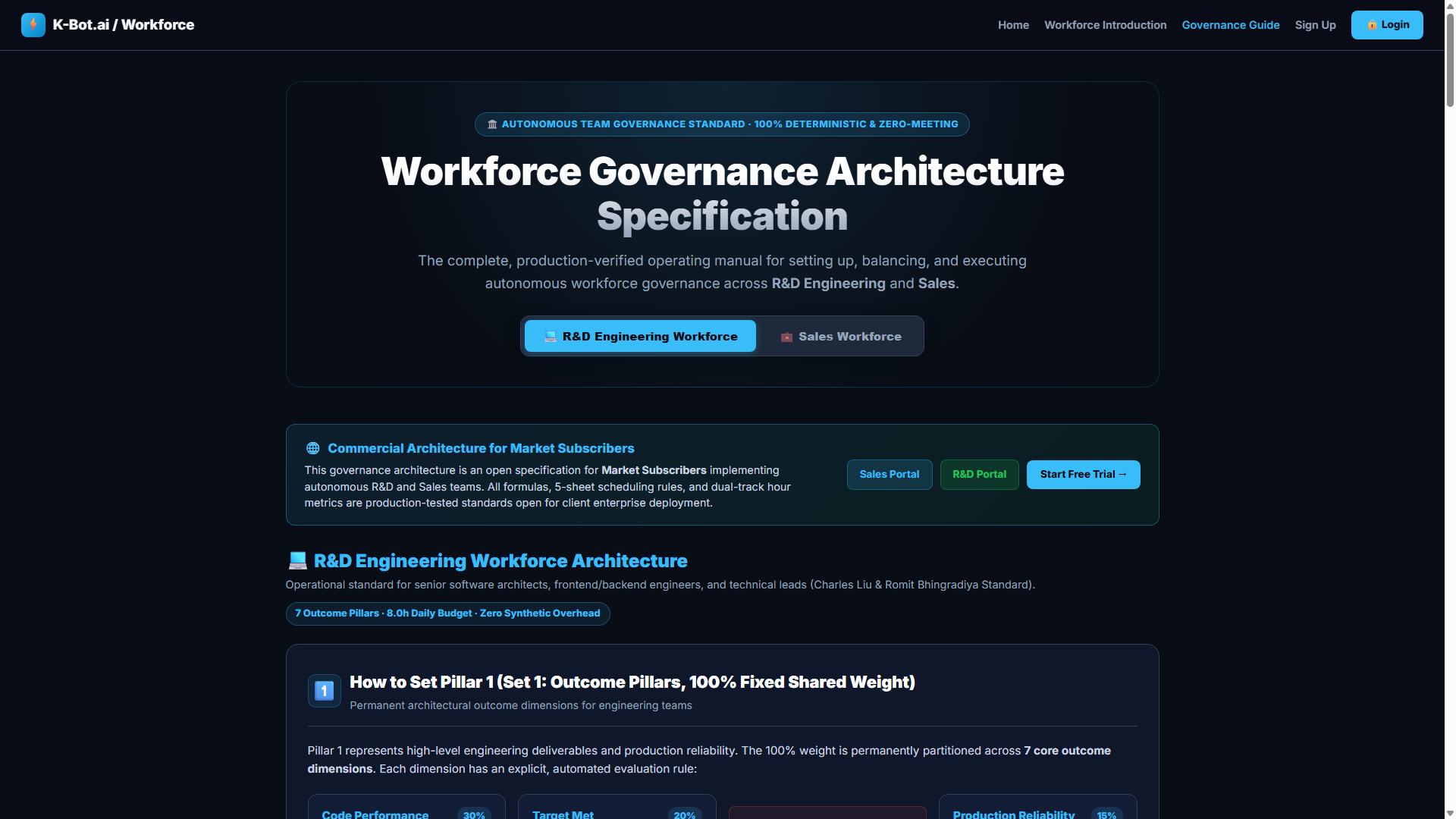
• Code Performance (30%)
• Target Met (20%)
• Production Reliability (15%)
• AI Progress Match (10%)
• Time Meets Required (10%)
• Reviews / Knowledge (10%)
• Schedule Meets Required (5%)
Track B (Human Usability): 3-minute usability signoff for visual UI deliverables.
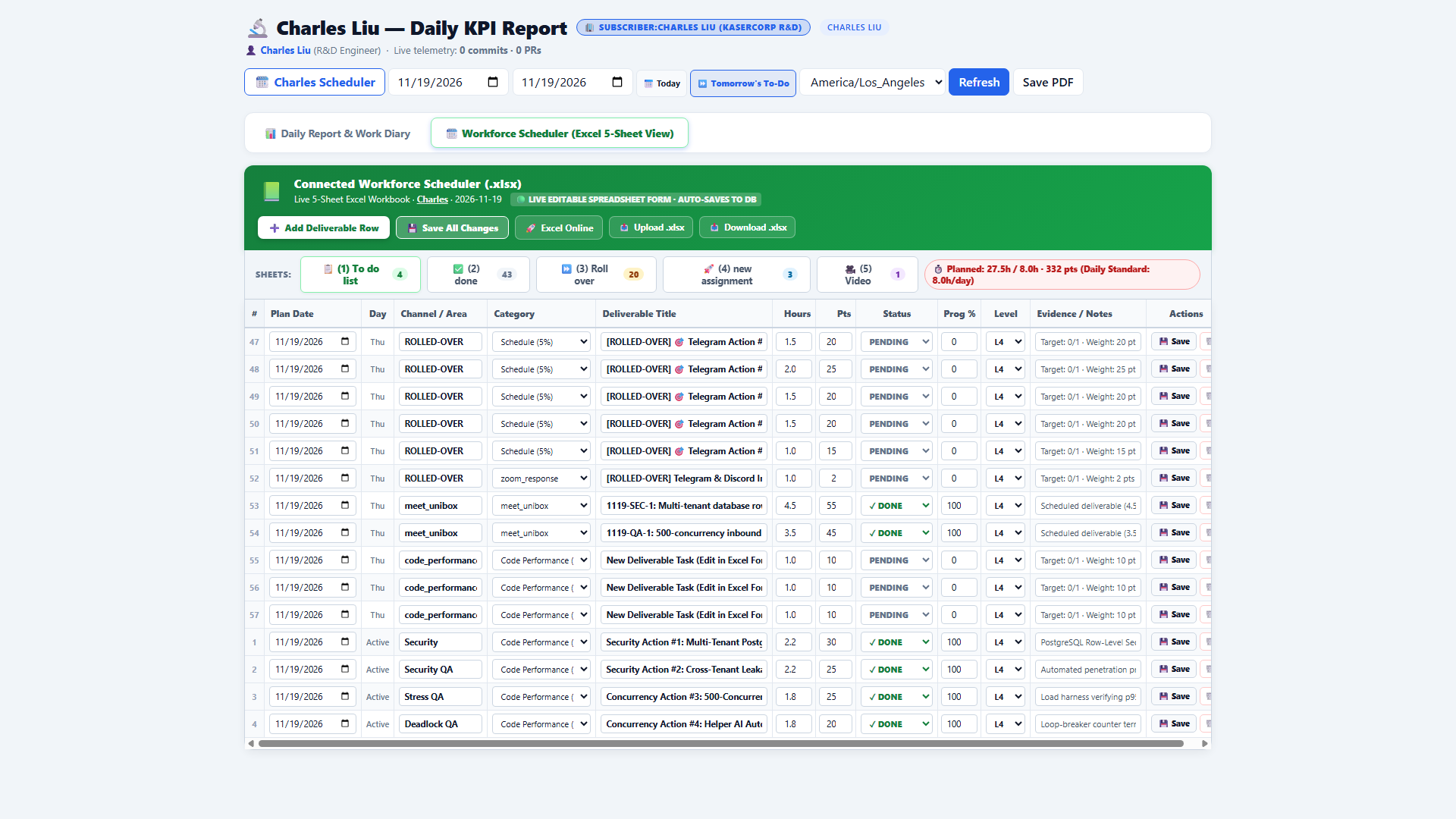
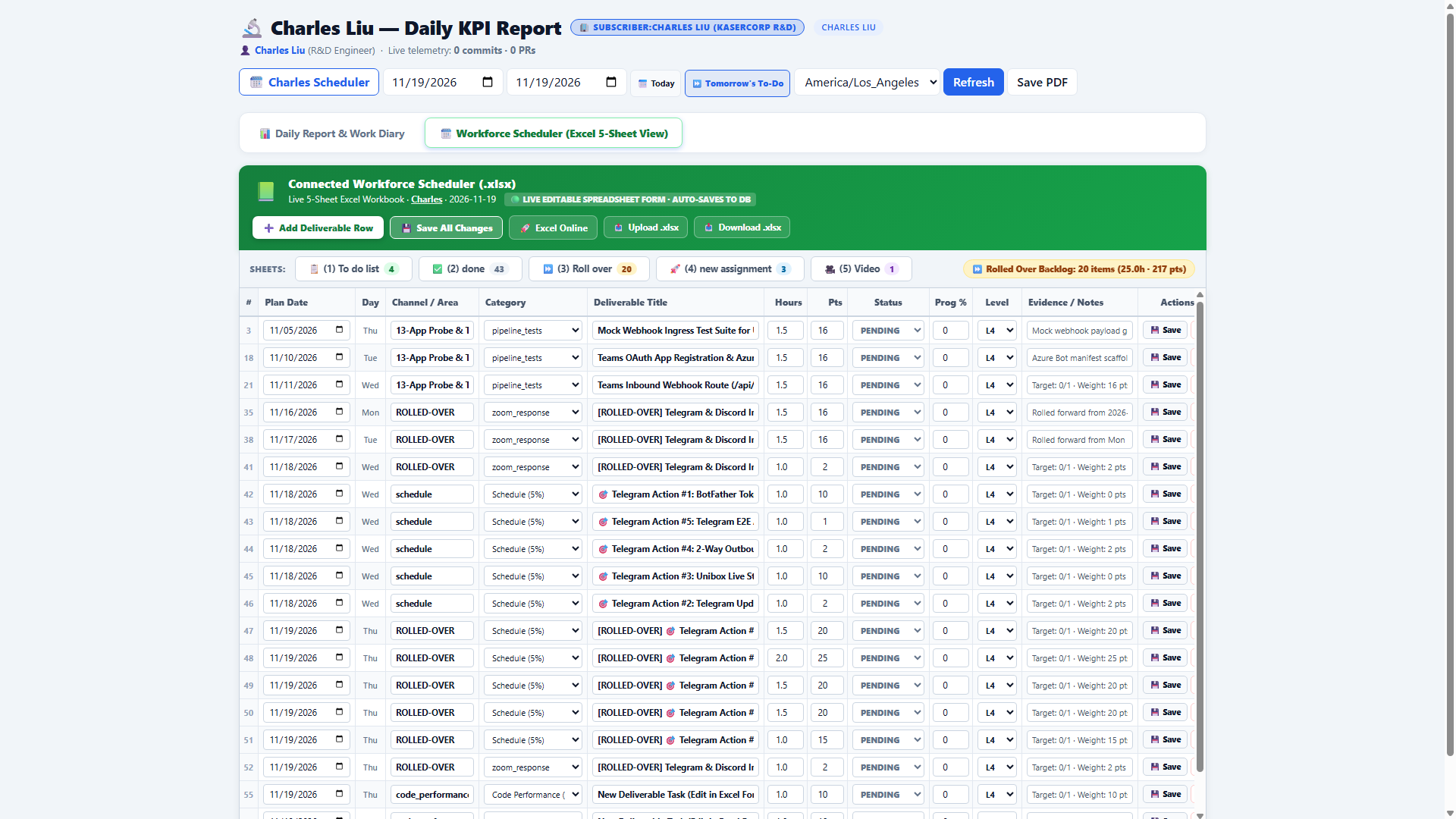
(1) To do list, (2) done, (3) Roll over, (4) new assignment, (5) Video.
Supports bulk editing, instant row addition, .xlsx download, and live upload sync.
• L1 Declared (1.0h): Isolated config/doc change
• L2 Handshake (1.2~1.6h): API stub & schema contract
• L3 Functional (1.6~2.0h): Core business logic & unit tests
• L4 Accepted (2.0~3.2h): End-to-end verified delivery
rnd_workforce), Git commit webhook integrations, and automated daily time-diary logging.
R&D Engineering Autonomy: Video Walkthroughs & Technical Telemetry
Note on Discipline Separation: The L1 → L2 → L3 (L3.1~L3.n) → L4 Genesis Pipeline is strictly dedicated to R&D Engineering Workforce. It ingests software repositories, unit test suites, and Sentry crash logs to replace standups with deterministic telemetry. Below are the official video walkthroughs and technical telemetry demonstrations:
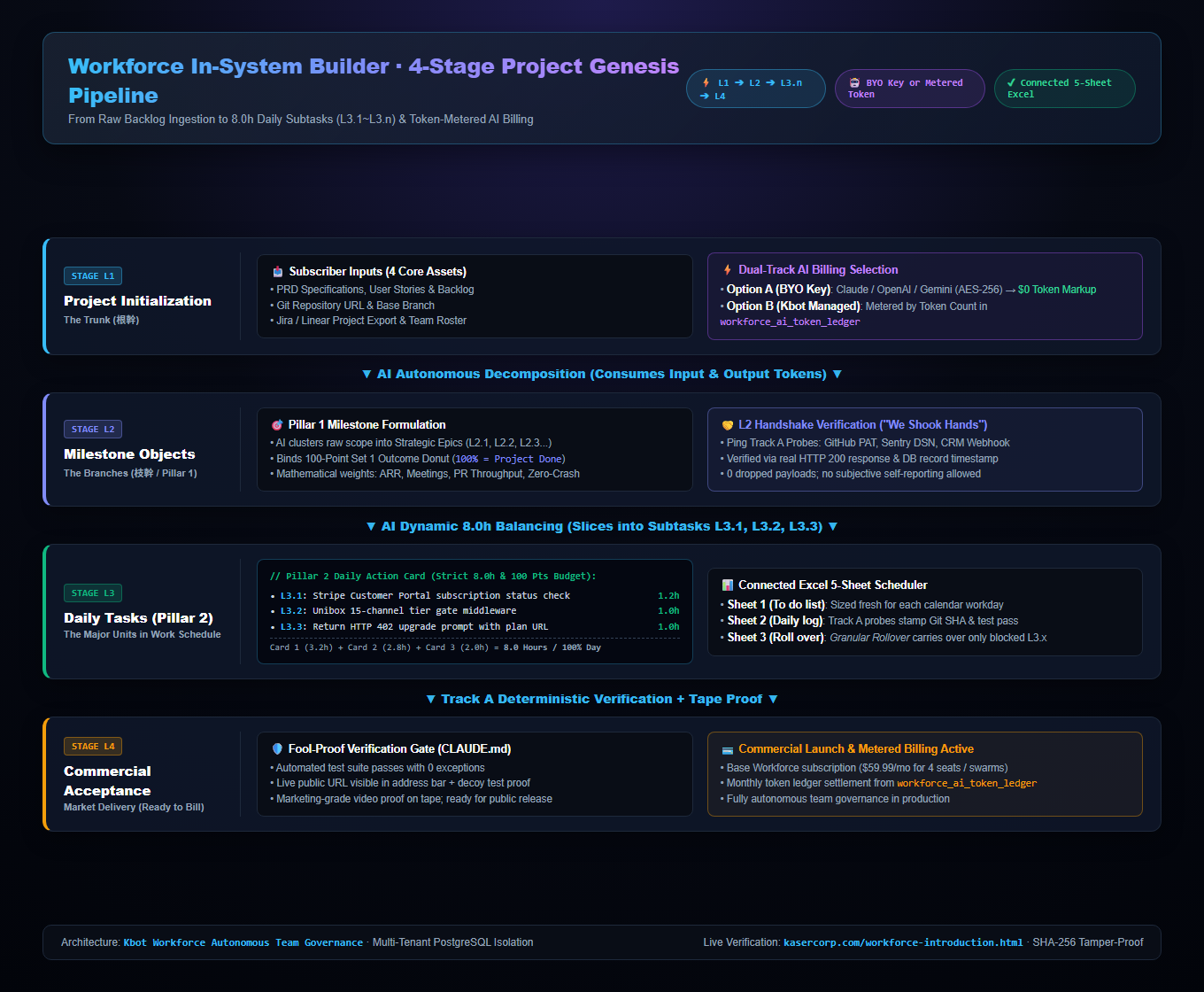
Pillar 1 & Pillar 2 Relationship · Dynamic Time · Worksheet Lifecycle
How macro engineering outcomes (Pillar 1) are dynamically driven by daily action cards (Pillar 2), strictly governed by 8.0h budgeting and the connected 5-sheet Excel scheduler.
1. Pillar 1 & Pillar 2 Relationship: The Kinetic Engine
Macro Architectural Accumulation powered by Daily Atomic Execution
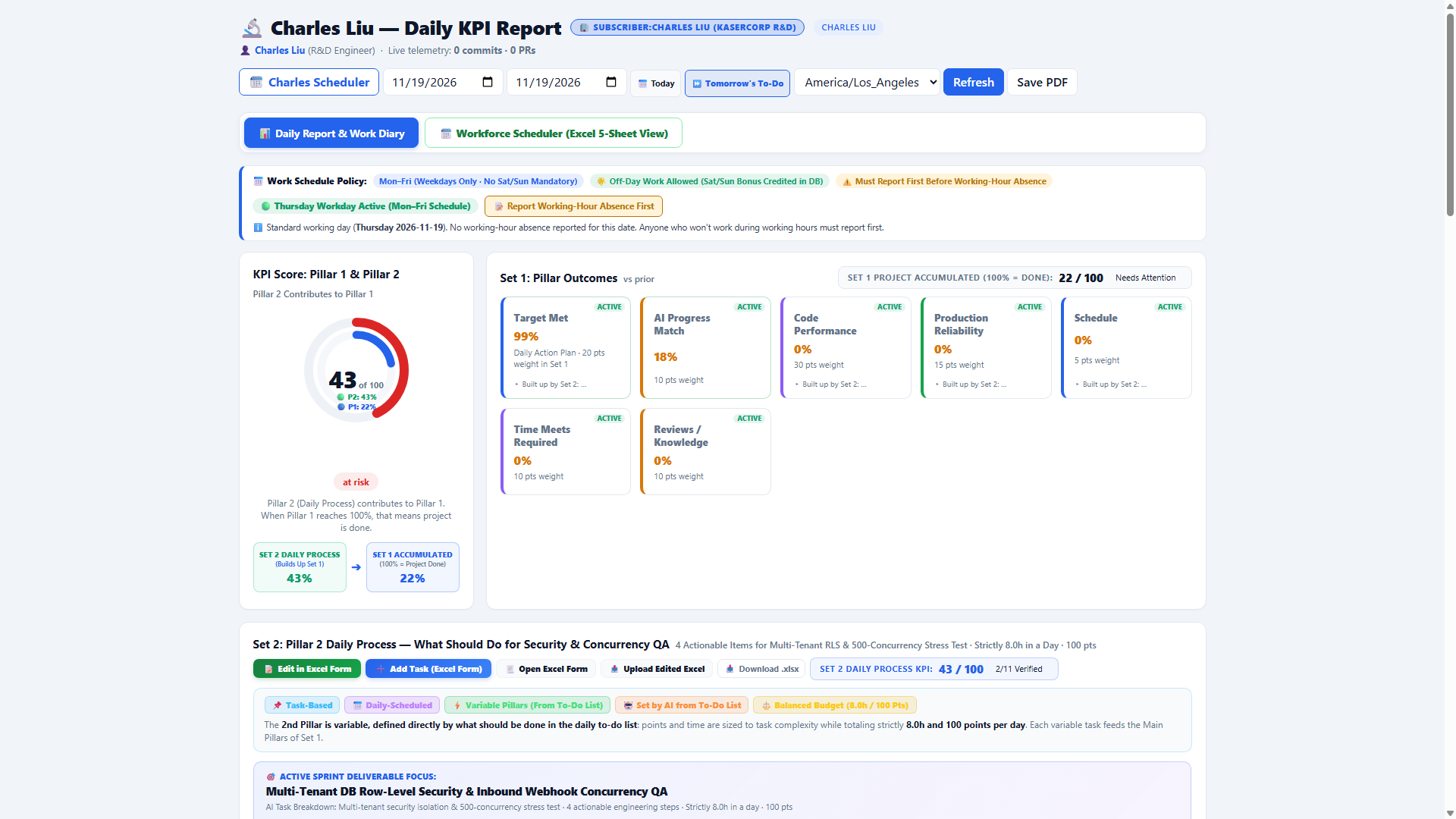
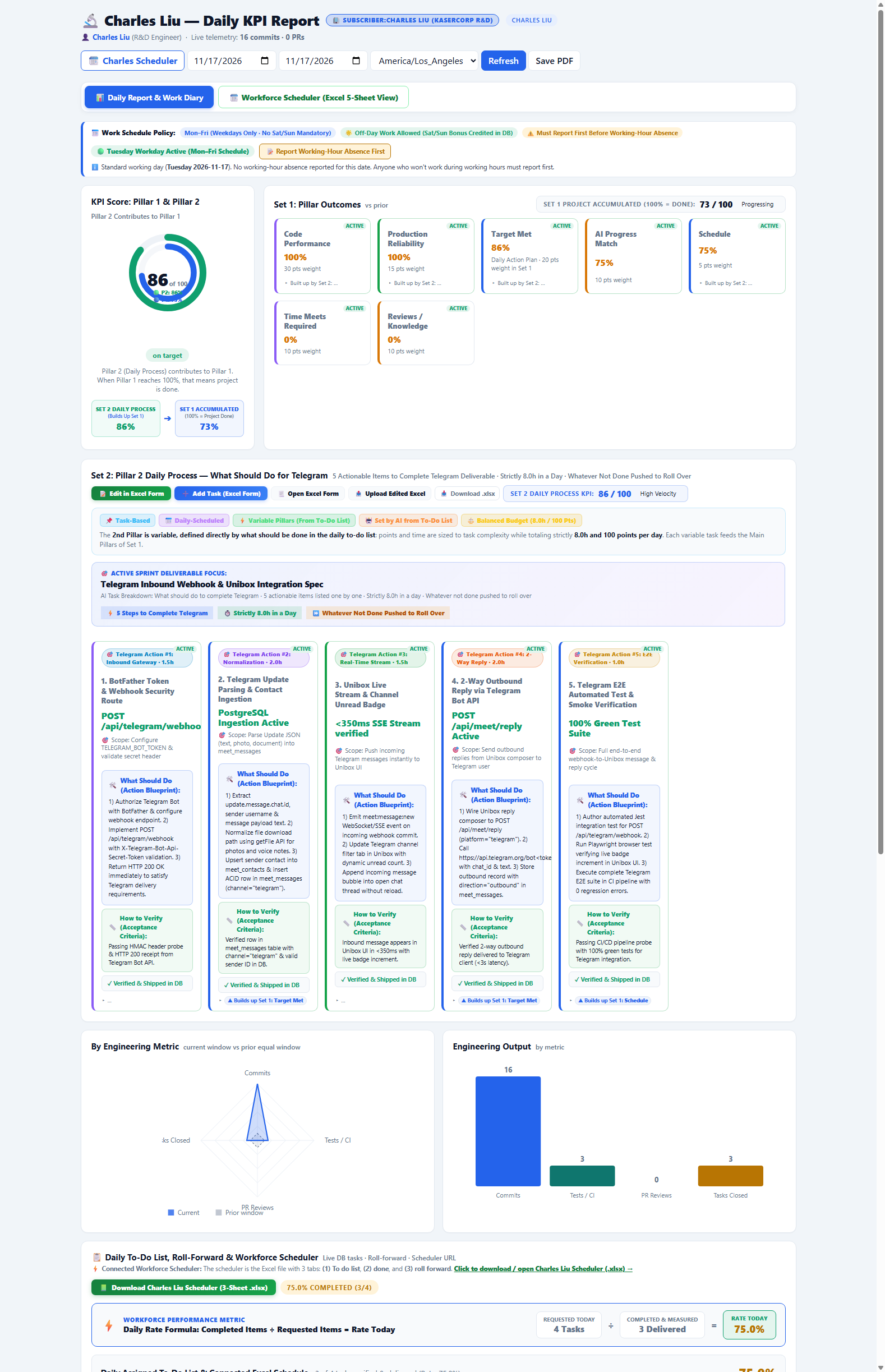
Pillar 1 (Outcome Dimensions, 100% Shared Weight) defines high-level engineering deliverables and production reliability (Code Performance 30%, Target Met 20%, Reliability 15%, AI Progress Match 10%, Time 10%, Reviews 10%, Schedule 5%). These weights are permanent and shared across the team.
Pillar 2 (Daily Process Execution, 8.0h / 100 Pts) governs the atomic tasks an engineer executes each day.
Pillar 2 is the kinetic engine that powers Pillar 1:
At clock-in, Code Performance (30%) and Production Reliability (15%) pass morning system checks (yielding 45 pts). However, Target Met (0%), AI Match (0%), Time (0%), and Schedule (0%) start at zero pending verifiable execution.
As each of the 4~5 Pillar 2 tasks passes Track A deterministic probes, Target Met scales: (Verified ÷ Assigned) × 20 pts. Combined with verified telemetry within the 85%~125% band, Pillar 1 hits a perfect 100% DONE.
2. How Pillar 2 Dynamic Time Is Set
Strict 8.0h Daily Constraint, Proportional 100 Pts, & Delivery Maturity Slicing
Engineers do not submit arbitrary hours. The AI-Helper enforces a strict mathematical envelope:
3. How Pillar 2 Develops from the 5-Sheet Worksheet
The Closed-Loop Excel Execution & Roll-Over Protocol
Pillar 2 is not static documentation; it is dynamically generated, executed, and archived through the connected Excel 5-Sheet Scheduler:
Active 8.0h queue. Decomposed into 4~5 action cards with explicit Track A deterministic probes (How to Measure).
Tasks move here automatically when probes PASS. Stores permanent Git commit SHAs, green CI tokens, and closure timestamps.
Unfinished tasks or dependency blockers are tagged [ROLLED-OVER] with root-cause analysis and automatically carried into tomorrow's Sheet 1.
Curated backlog pool of upcoming epics and architectural refactors maintained by tech leads to feed future sprint sheets.
3-minute Loom walkthrough recordings mandatory for user-facing UI deliverables to satisfy non-author Track B signoff.
How AI Learns Subscriber Engineering Capability
Zero subjective reviews. Zero LLM hallucinations. The AI-Helper quantifies developer skill and velocity through continuous deterministic telemetry, L1~L4 maturity progression, and closed-loop feedback.
1. The 5 Deterministic Telemetry Signals
Objective system signals captured directly from Git, CI/CD, and developer environments
2. L1~L4 Delivery Maturity & Skill Progression
How AI unlocks complex architectural responsibilities based on verified delivery
When an engineer joins a subscriber workspace, the AI-Helper assigns baseline L1~L2 tasks. As the engineer demonstrates consistent delivery within the 85%~125% compliance band, higher architectural tiers are unlocked:
3. Workstation Telemetry & Three-Way Agreement Calibration
Real-time focus window weights and self-learning estimation models
• IDE, Terminal, Git, Docker: Full 1.0x rate.
• Zoom, Slack, Handover Docs: 0.5x communication rate.
• Inactivity > 5 Minutes: Auto-paused (0.0x rate) to eliminate synthetic time inflation.
Before each sprint: AI Proposes Hours → Developer Counters → Tech Lead Approves.
The system calculates variance against probe verification to continuously refine future task sizing models for that repository.
4. The 30-Day Subscriber Learning Lifecycle
From raw baseline calibration to autonomous team optimization
System observes initial commit velocity, idle tolerance, and Track A probe latency to establish team baselines.
AI-Helper auto-sizes Sheet 1 action cards to match each developer's natural capacity (zero burnout, zero under-utilization).
Nightly scoring engine generates rolling 30-day appraisals with bias-free compensation and promotion recommendations.
Explore the Workforce Commercial Walkthrough
The complete 10-scene commercial breakdown built for market subscribers. Click any scene below to preview the high-resolution visual proof and word-for-word Descript narration script.
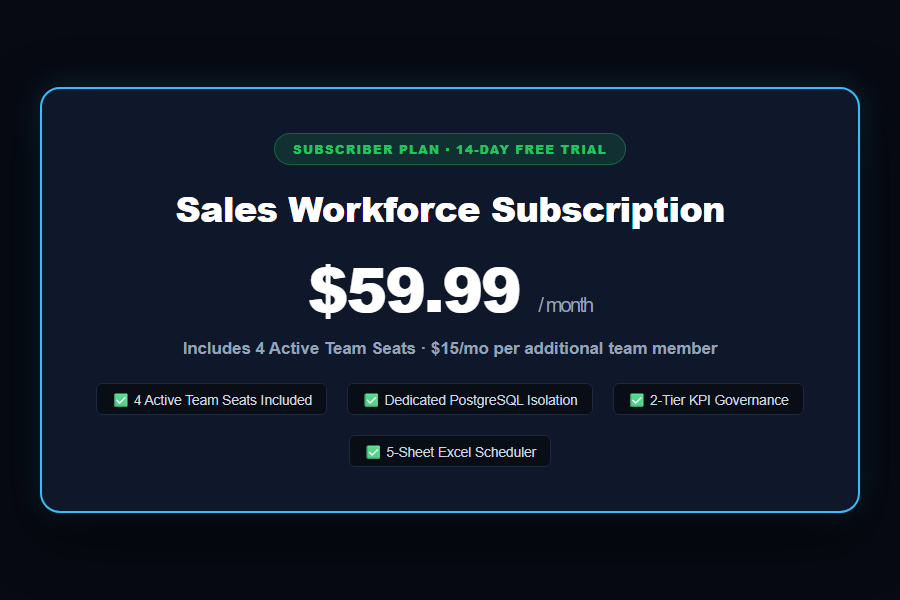
R&D Workforce Subscription
Includes 4 Active Team Seats · $15/mo per additional team member
Ready to Onboard Your Engineering Team?
Follow our 4-step subscriber intake payload protocol to connect your Git repositories, assign engineer roles, and launch your autonomous workspace.